Meet Borneo orangutans as you cruise through a jungle river in the untamed Tanjung Putin National park, where adventure meets wilderness and romance. Join us in our mission to support local communities and protect the rainforest.
Borneo Orangutan Tours
3D2N Orangutan Tour See all highlights!
We cruise with a wooden klotok houseboat in Tanjung Puting, visit all three feeding stations and Camp Leaky, have traditional meals aboard, and see fireflies at night if weather conditions allow.
4D3N Orangutan Tour More jungle time!
Additionally, we do small jungle treks, a night trek, and we visit the reforestation site or the local Sekonyer village.
5D4N Orangutan Tour Off-the-beaten path!
Embark on off-the-beaten-path treks with rangers and a scenic canoe ride along a narrow jungle river. Be ready to get a little muddy as you immerse yourself in the secluded parts of the national park.
6D5N Photography Tour Limited Availability
Introducing our newly launched tour away from the crowd, developed in collaboration with rangers. The highlight is the crocodile expedition at night.


Borneo Dayak Tours
Complement your orangutan tour with a visit to a Dayak jungle tribe. Stay overnight in a traditional longhouse and camp in a tent by a jungle waterfall.


Shared Orangutan Tours
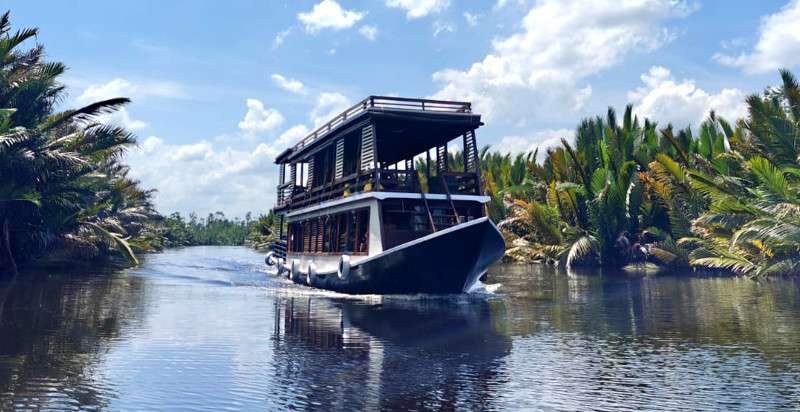
For eco-conscious travelers and those looking to meet others, we offer open tours in our new deluxe klotok “Lidia” — featuring spacious decks, 4 bathrooms, 2 jungle view cabins for couples, and a Royal Master Suite for families.
Looking for shared trips outside the open tour schedule? Hook up with other solo travelers in the Solo Travelers Forum and book a private tour together.
Do you prefer long treks through a primary rainforest where you would sleep in camps next to jungle rivers? Then check-out our orangutan tours in Sumatra.
We’re fun Tanjung Puting Guides:-)
We are born and raised around Tanjung Puting National Park. We know the orangutans by name and the jungle trails by heart, and are eco-minded.
We are experienced, listen carefully to your wishes, and are excited to show our backyard. Whether you want to see orangutans, learn about local situation, or are outdoors, a family or a photographer: You’ll find yourself in great company with us.


Our Klotok Houseboats
The boat is half the fun! We use comfortable Klotoks with a Western shower (no Mandi) and toilet (no squat toilet) and with fresh water (no river water).
With our private tours, the boat is exclusively yours. Mineral water is available throughout the day.


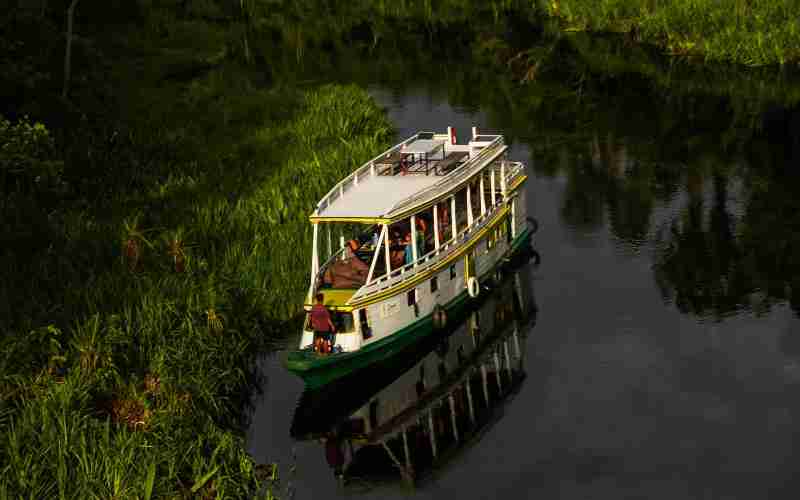


A fully renovated large klotok with 2 lounge areas: one with bean bags in the front and one with a wooden bench in the back. It has a dining area and a sleeping area (in the middle), and a Western shower with fresh water and a Western toilet. Mineral water, coffee and tea available throughout the day. The maximum capacity is 8 people.


FAQ on Tanjung Puting
What is the price for the orangutan tour in Tanjung Puting?
The price for a private 3D2N orangutan tour starts at 3.8 million IDR per person for a group of 4 people. The final price varies depending on your group size, tour duration, and travel dates, and can be found instantly on the Local Guides booking form.
How to get to Tanjung Puting National Park?
The gateway to Tanjung Puting National Park is Pangkalan Bun - a relatively large city in South Kalimantan with an airport. There are direct flights between Pangkalan Bun and Jakarta, Semarang and Surabaya. From Pangkalan Bun it is a short drive to the harbour in Kumai, we enter the klotok houseboat and cruise for ca 1 hour to the gate of Tanjung Puting National Park.
Are flights to Pangkalan Bun reliable?
It is not uncommon that flights to Pangkalan Bun are delayed, and - while rare - they can even be cancelled on a short notice. Since the tour cannot be changed on such short notice, the best practice is to arrive in Pangkalan Bun the day before the orangutan tour starts.
In case you want to take the (small) risk of arriving in the morning that the tour starts, we recommend to take a travel insurance (to be compensated for the shortened tour in the event of a flight cancellation), or book at least a 4 day orangutan tour - if everything goes fine you just have an amazing orangutan tour without any insurance fees, and if the flight gets cancelled you will could do a wicked 3D2N orangutan tour and consider the extra price you have paid an insurance fee.
Where to stay in Pangkalan Bun?
It is common for visitors to start the tour upon arrival at the airport, and to fly out on the same day the tour ends. In order to start the tour rested and to accommodate the risk of a delay of your flight, you could consider to start the tour on the day after your arrival and spend the night at a good hotel in Pangkalan Bun.
Because the tour ends early on the last day, there is no need to stay overnight at the end of the tour, except if you would like to rest and enjoy a hot shower before flying to your next destination.
Recommended hotels in Pangkalan Bun in the top, middle and budget segment are the Grand Kecubung Hotel , Arsela Hotel and Hotel Bahagia , respectively.
What is the best period to visit Tanjung Puting National Park?
You can visit Tanjung Puting throughout the year. The temperature is rather constant and while it is often raining in a rainforest, historically the most dry period has been July-September and the most wet period has been January and February. However, in recent years the rainfall has been more unpredictable, so the above should not be delt with too strictly.
Partly for the above reason, the most popular period to visit Tanjung Puting among travelers is between June and September. However, besides the weather advantages of this period, there are several downside of doing your tour in the period June - September:
- It is very crowded, which spoils the experience for some people.
- It is relatively expensive since there is a lot of demand and limited boat availability.
Considering the crowds and the value for money, in our opinion the best time to visit Tanjung Puting is in the shoulder months March & May and October & November. Even the wet months (December, January, February) are very nice months for visitation since the wet season is usually relatively mild in Tanjung Puting National Park.
In case you don't have the flexibility and are restricted to the high season period, as long as you manage your expectations that it will be crowded and you book your tour well on time (at least 5 months notice), you will still have a wonderful experience!
What time does the orangutan tour start and end?
Pick-up is at 10 am at the lobby of your hotel in Pangkalan Bun. In case you arrive in Pangkalan Bun on the same day that your tour starts, we pick you up at the airport and start the tour immediately. If you land before 11:30 am we will follow the default tour itinerary. We can also accommodate (but not advice) an arrival in the afternoon, but then you obviously will have less time in the park.
Note: In order to see the feeding at Tanjung Harapan - which starts at 3pm - we need to leave Pangkalan Bun latest at 11:30 am. It is recommended to fly to Pangkalan Bun the day before the tour starts to avoid that a flight cancellation (small but real chance) would ruin the trip.
The tour ends on the last day early in the morning, and you will be dropped off at the airport (or your hotel) between 6:30 and 9 am depending on your flight schedule. As long as you mention your flight schedule in the booking form and you are ok with getting up early, you can even catch a flight as early as 7:30 am.
Should I arrive the day before the tour starts in Pangkalan Bun?
Yes! In fact, this is such an important point, that we emphasize this also in other parts of this FAQ.
While rare, flights to Pangkalan Bun are cancelled sometimes, and when that happens it is usually on a very short notice. This is a stressful event, further exacerbated by a poor reachability of the customer service of airlines. If your orangutan tour starts on the same morning that your flight should arrive in Pangkalan Bun, then a flight cancellation usually means that you have to take a flight on the next morning; your tour starts a day later and you have to shorten your tour by one day. Since we prepare everything for the dates that you have booked, you would have to still pay the full price also if we have to shorten the tour by a day. To prevent that a flight cancellation ruins your holiday, we advice you to take at least one of the following measures to accommodate flight cancellations:
- Take a travel insurance
- Arrive in Pangkalan Bun the day before your tour starts
- If you want to start the tour right away regardless, then book at least a 4 day orangutan tour. If everything goes fine you just have a nice orangutan tour without any travel insurance fees. If your flight gets cancelled, you could still do that is shortened by one day, and the extra price you have paid is the replacement of a travel insurance fee.
Should I take the 3D, 4D or 5D tour?
3D2N. We advice to take the 3D2N tour if you want to see as much as possible in as little time as possible. It is fantastic value for money as you get to see all feeding stations in Tanjung Puting. Unfortunately, you will not have any time for a short trek, or a night trek.
Note: It is recommended to arrive in Pangkalan Bun the day before the tour starts, which is important in particular for the 3D2N Orangutan Tour. If your orangutan tour starts on the same morning that your flight should arrive in Pangkalan Bun, then a flight cancellation usually means that you have to take a flight on the next morning; your tour starts a day later and you have to shorten your tour by one day. Since a 3D2N orangutan tour is the bare minimum that is recommended, shortening the 3D2N tour by one day is impractical. Moreover, since we prepare everything for the dates that you have booked, you would still have to pay the full price for the tour you have booked and not for the tour you got following your flight cancellation.
4D3N. The 4D3N tour we advice to anyone who would like to take the time in Tanjung Puting and is especially interested to combine visiting the feeding stations with short jungle treks and a night walk. You would also visit a reforestation site and the Sekonyer jungle village.
5D4N. The 5D4N tour we advice to anyone that is more adventurous, is into a long jungle trek, together with rangers in a more remote part of the rainforest. At the end of the jungle trek, we return to our boat by a canoe through a small jungle river. There are no other activities in Tanjung Puting that will take you further away from the crowd than this trek, but be prepared to get a little bit dirty.
What meals are served during the tour?
This is one of the things we try to stand out with!
Our goal is to spoil our guests with mouthwatering, delicious meals, because we realize that it adds to the experience to have a well prepared meal in the heart of the jungle on a romantic wooden boat.
Breakfast, Lunch and Dinner are served in the top deck on the dining area, while the fingerfood, snacks and drinks are served throughout the day. You’ll have access all day to tea and coffee. If you have a preference for a specific drink, please let us know in advance via the booking form.
Do you have any dietary wishes? Vegetarian, Vegan, nut or gluten allergies? No worries, we have that all the time. Just let know about it and we'll take care of it.
What are the facilities on the boat?
The boat is a traditional Klotok wooden river boat.
We use comfortable Klotoks, with simple but Western toilets and a shower, as opposed to an Indonesian squat toilet or a basket of water to shower in ("Mandi").
There is a top deck exclusively for you, with a dining table in the back, a lounge area in the front and mattrasses under a mosquito net that will be prepared for you in the evening. The crew is in the bottom deck.
Do I share the boat with other travelers?
No, by default our orangutan tours are private. This means that the boat is exclusively for your group and that you have your own personal boat crew.
However, since recently we also offer the possibility to book a shared orangutan tour to reduce cost and the carbon footprint.
Can I get seasick on the boat?
No, that is highly unlikely. The river is quite still, and small waves are only occasionally created by passing boats.
Will I get wet on the boat when it rains?
No. Although the boats are on default open on the sides to allow visibility towards the forest, in case of rain they can be closed completely with removable tarps.
Which animals live in Tanjung Puting National Park?
The main reason people visit Tanjung Puting is because of the Orangutans, the park is also home to the bizarre looking proboscis monkey with its “Jimmy Durante” nose as well as seven other primate species. Clouded leopards, civets, and Malaysian sun bears cavort in the park, as do mouse deer, barking deer, sambar deer, and the wild cattle known as banteng.
There are over 230 species of birds, including hornbills, deep forest birds, and many wetland species. Tanjung Puting is well known for its “bird lakes,” seasonal rookeries for a half a dozen species of endangered waterbirds, including the only known Bornean nesting grounds for white egrets.
There are two species of crocodiles (you may spot one while cruising!), dozens of snakes and frogs, numerous threatened species, including the fortune-bringing and highly endangered “dragon” fish also known as the Arwana (bony-tongue).
Among the most flamboyant of these animals are the many species of colorful birds, butterflies, and moths found in the Park.
How does the rainforest look like in Tanjung Puting National Park?
In Tanjung Puting National Park, you'll see the lasting marks of environmental harm from the 1990s, alongside the park's remarkable comeback, largely thanks to tourism.
As we float down the Sekonyer River on our Klotok, lush plants line both sides. But take a closer look: the National Park thrives on the right bank, while the left is dominated by palm oil plantations. Luckily, the National Park itself remains mostly untouched by the palm oil industry. However, rampant illegal logging before the 1990s, along with forest fires, has led to much of the rainforest regrowing, resulting in mostly secondary forest today.
The rise of orangutan tours has changed things. Local communities now benefit more from preserving the rainforest than destroying it. This has led to a remarkable recovery in recent years, making Tanjung Puting National Park a shining example of successful eco-tourism.
How much should I tip the staff?
Tipping is common in Indonesia, and the staff will be extremely happy and flattered if you decide to do so, but it is of course voluntary and not expected.
There is no rule for how much to tip, as it really depends on how satisfied you are with the service and on your budget. Some clients really insist to get an indication, so we will give the rule of thumb that for every day couples could consider tipping the guide 100.000 IDR per day and 50.000 IDR per day to the cook, captain and boat helper each.
Please consider this very indicative, and deviate from it as you wish, depending on your budget and your group size. In the end, any amount is really appreciated.
Are there other places where i can see orangutans?
Among the best places in the world to see orangutans are Tanjung Puting National Park (Kalimantan) and Gunung Leuser National Park (Sumatra). We offer tours in both places with certified, local guides.
Both are quite well accessible by air from Jakarta. Which of the two is better, depends on your personal interests and on your budget.
Generally speaking, orangutan tours in Bukit Lawang are suitable for adventurous travelers that like relatively long treks, are in shape, and love to camp in the jungle. The tour is by foot and the accommodation is typically in basic jungle camps. We return with an exciting tube raft via the jungle river. Additional advantages are that you can combine such orangutan trek with other activities (volcano treks in Berastagi, relaxing at Lake Toba, visiting villages, cycling tours etc.) and that it is relatively cheaper than the orangutan tours in Borneo. Because the tour is private, we can easily adjust the trek length and difficulty to the ability and wishes of the group and therefore this tour is also suitable for families with children.
In contrast, the orangutan tours in Tanjung Puting are by boat as you cruise through the river, and the occassional treks are very easy and short, and the accommodation is typically on the boat. It is ideal for travelers that want the excitement of a jungle adventure, but without the practicality issues of not having a (good) toilet or shower or sleeping on a thin mattress. Another practical advantage is that the location where the tour starts and ends - Pangkalan Bun - has an airport. Although this cruise is still relatively cheap for Western standards, it is ca 2 times more expensive than the jungle treks in Bukit Lawang. Also, there are fewer activities around Tanjung Puting National Park, than around Gunung Leuser National Park.
Are there any general tips?
Here are a few additional tips that you may enhance your tour experience:
1. Although Indonesia is famous for its coffee, in our experience, tourists do not like the standard coffee served at homes or in the boat, which is basically hot water with filter coffee, but then unfiltered. So if you drink coffee, we recommend to bring your own instant coffee (or French Press).
2. You may want to consider to bring your own alcoholic drink to optimally enjoy the beautiful and romantic setting from the Klotok. If you are lucky, you can store these in the fridge of the staff, but chances are that you can only drink it warm. Alcoholic beverage is not sold in Pangkalan Bun and therefore needs to be bought before arriving here.
3. In case you have time, you will appreciate staying overnight in Pangkalan Bun before (and/or after your) tour. You'll start your tour all rested, finish your tour with a hot shower, stay longer in Tanjung Puting National Park, and don't need to stress about flight delays. The best hotel in town is the Grand Kecubung Hotel .
4. Although there are plug sockets aboard, we do not recommend to use these to charge expensive gadgets (smartphones, tablets, etc.) because the power engine of the boat does not supply a constant voltage (this holds for ALL boats). Please consider to bring an external battery charger, which can be bought at any outdoor store.
5. If you have a hammock, bring it! The ultimate chill experience is to lay down in your hammock in the klotok as you cruise through the lush jungle!
6. Bring a refillable bottle, not only for your trip to Tanjung Puting but generally for your stay in Indonesia. You would dramatically reduce your plastic consumption by not using a plastic mineral water bottles. You can refill the bottle with the large mineral water barrel we have onboard.
7. Purchase online an e-simcard before you arrive in Indonesia. You don't need a physical card (hence "e"-simcard), and there are many providers, such as MobiMatter. Download the app and just purchase it if you have a smartphone.
Recommended Accommodations


Reading Tips


Address
What happens if my flight is delayed?
Our advice is to arrive in Pangkalan Bun the day before your tour starts. In case of a flight delay, there will be no implications for the tour.
In case the tour starts on the same day the flight was supposed to arrive, then a flight delay means the tour starts at the delayed arrival time. Depending on how much the flight is delayed, the itinerary may be customised. No (partial) refund applies for the shortened tour.
What happens if my flight is cancelled?
Our advice is to arrive in Pangkalan Bun the day before your tour starts. In case of a last-minute flight cancellation, a new flight could usually be booked for the next day, and there will be no implications for the tour.
In case the tour starts on the same day the flight was supposed to arrive, then a flight cancellation usually means the tour starts a day later than what was booked:
- In case your flight is cancelled 2 weeks prior to tour start, you can change your booking details with us without penalties, but this is subject to availability.
- In case your flight is cancelled within 2 weeks prior to tour start (usually flights are cancelled on a very short notice), we are not able to change your booking. The tour will start upon your arrival a day later, but since we have hired the boat and the boat staff for the cancelled day as well, there is no refund for the lost day.
To prevent that a flight cancellation ruins your holiday, we advice you to take a travel insurance and book flights that arrive the day before your tour starts.
PS: While rare, flights to Pangkalan Bun are cancelled sometimes. This is a stressful event, and since airlines are not easily reachable, sometimes clients take it out on us and demand a refund for the cancelled day. While a flight cancellation is an event beyond the client's responsibility, it is also beyond our responsibility. Our responsibility is to organize the tour for the dates that the client has booked, for which costs need to be made in advance. In return it is the client's responsibility to be here at the start of the tour. And for unforeseen events that could complicate that, clients can take a travel insurance.

Cruise through the Borneo jungle

The unknown scenic treks in Sulawesi

Bukit Lawang Jungle Trekking in Sumatra

Meet the giant dragon and enjoy the snorkelling

Meet traditional tribes off-the-beaten track

Encounter the adorable Tarsier
In Indonesia children need to wear uniforms at school, partly to hide social class differences.
But poor families can't afford good shoes for their children. Or replace a damaged uniform...
The psychological framing at this formative age could affect their self-image for life.
Join us with restoring the children's dignity by donating shoes & uniforms to schools in Flores.

Conservation
The jobs created with our jungle tours, incentivises locals to stop palm oil deforestation.
Local Welfare
Our initiatives aim to help the underprivileged. Our tours are built on community engagement.
Education
Enhance your cultural and environmental awareness via our tours and eco blog and become an ambassador for eco travelling.